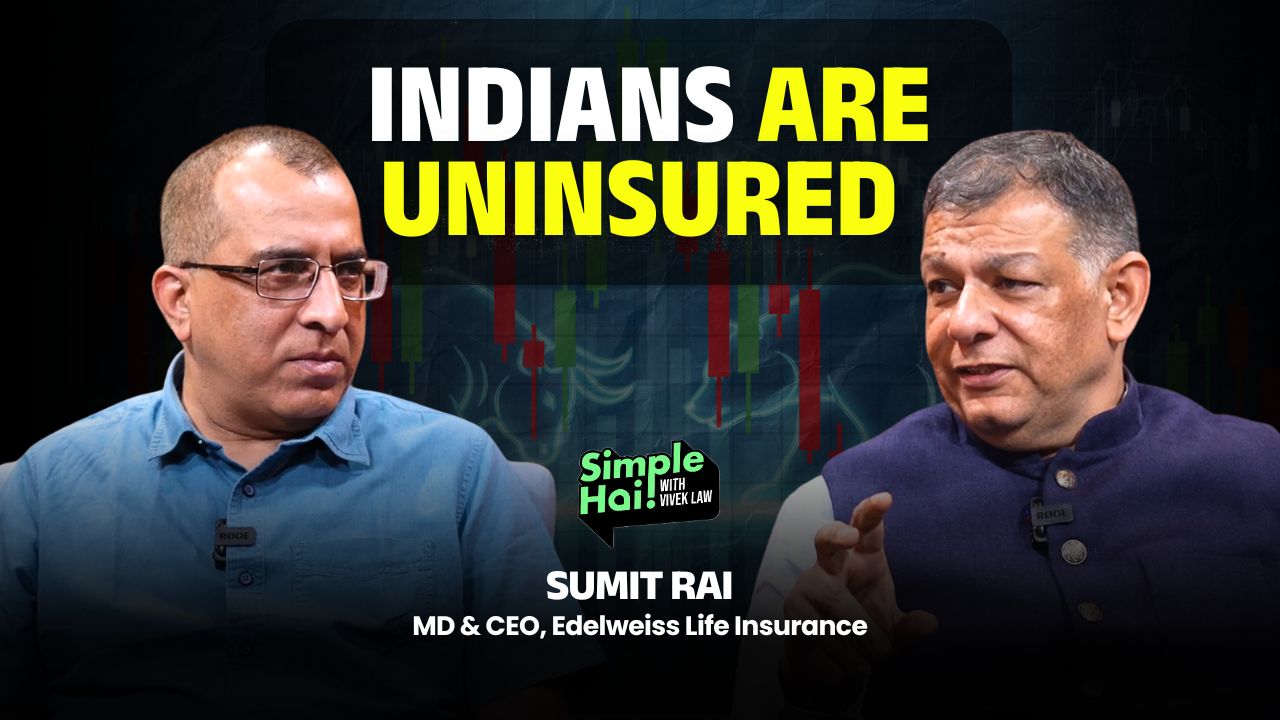
“Humans undervalue their lives, that’s why they end up opting for either too little insurance or none at all.” said Sumit Rai, MD & CEO of Edelweiss Life insurance on the latest podcast episode of Simple Hai! with Vivek Law. This episode went beyond insurance products and policies to confront a deeper discomfort most Indians have with thinking about uncertainty, illness, and death.
In this conversation, Vivek Law Editor-in-Chief of Simple Hai!, sat down with Rai, to unpack why life insurance is still misunderstood, underused, and often postponed and why that hesitation can be financially devastating.
Insurance Before Investing: A Hard But Necessary Truth
The episode opened with a clear, almost uncomfortable assertion: before you think of SIPs, stocks or any other investments, you must first secure Term Insurance and Health Insurance. Not as an option, but as a foundation.
Rai underscored the importance of critical illness coverage and the advantages of buying insurance early in life. The logic is simple: premiums are lower, medical complications are fewer, and coverage is more comprehensive. Yet, despite this clarity, adoption remains poor — a paradox the episode repeatedly returns to.
The Sandwich Generation And The Impatience Trap
Rai’s research highlights the growing pressure on India’s “sandwich generation”, which according to him are those who support aging parents while funding increasingly expensive aspirations for children. Longer life spans, rising healthcare costs, and education inflation are creating financial and mental strain.
Compounding this is what Rai calls the curse of liquidity. SIPs are started enthusiastically and stopped within months. Long-term products are avoided. Quick gratification from trading, crypto, lifestyle upgrades is often winning over patience.
The irony, he noted, is that impatience itself is expensive.
The Real Problem: Undervaluing Life
Why does term insurance struggle despite logic being firmly on its side?
Here, Rai pointed to a fundamental issue: poor understanding of Human Life Value. People struggle with the idea of paying premiums for decades without receiving anything back if they survive. Insurance feels like “wasted money” because its value lies in protection, not returns.
Indians are comfortable saving, because saving assumes survival. But they avoid planning for death or disability. This gap, Rai believes, reflects weak financial education rather than distributor apathy, though low commissions don’t help. Interestingly, cities with higher awareness, like Bhopal, see strong online adoption where people buy cover independently.
Underinsurance, GST Relief, And Buying Early
Despite nearly 60% of Indians being “covered” in some form, most are severely under-insured. Many young professionals rely entirely on employer-provided group cover, ignoring the fact that a job change or layoff can erase that safety net overnight.
Rai offered a simple thumb rule: term cover should be at least 10 times annual income. For instance a ₹10 lakh salary calls for a ₹1 crore cover which has to be reviewed every 3-4 years as income grows. On health insurance, he warneds that ₹2-3 lakh policies are no longer realistic in an era of expensive surgeries and long hospital stays.
Buying early matters not for compounding, but for certainty. Premiums rise sharply with age, and health conditions can lead to heavy loading or outright rejection. A policy bought at age 25 can cost more than double if purchased at 35.
Recent GST concessions on term and health insurance could help revive interest. As Rai explained, the savings can either reduce cost or significantly increase coverage, a rare win-win.
COVID-19: Awareness Without Action
The conversation then shifted to the seismic impact of COVID-19. For the first time in decades, mortality became visible in young and old alike. Families witnessed not just death, but the financial chaos that followed.
According to Rai, the pandemic triggered two realizations. First, the myth that death only comes in old age collapsed. Second, people understood that income itself is fragile. This led to a surge in demand for term insurance, health cover, and income-guarantee products through 2021.
But the momentum didn’t last.
While awareness remains higher than pre-COVID levels, urgency has faded. Inflation and rising daily expenses have softened demand. Term insurance penetration, Rai noteds, still sits at just 4–6% which is far below what a country like India needs.
Rai’s Journey: Clarity Over Convention
Rai’s own career path offers a powerful counter-narrative to India’s obsession with linear success. With nearly 30 years of experience, largely in insurance and earlier in banking, his academic background is anything but conventional.
After studying Liberal Arts at Allahabad University, he went on to pursue an MBA. For Law, this journey is particularly inspiring because it challenges the idea that only engineers or commerce graduates can rise to leadership roles in India’s aspirational economy.
Rai added that success is not about academic labels. It is about clarity of purpose and sustained effort. He credits his interest in finance to childhood exposure, business magazines at home, a strong reading habit, and growing up without television until his teens. Reading, he told Law, shaped his curiosity and thinking far more than any formal plan.
Interestingly, although he entered finance through sales, despite being introverted in his youth, he found joy in the work. His reflection is disarming: life is rarely as planned as people imagine. Progress comes from staying in motion, showing up consistently, and remaining open to where effort takes you.
Owning Your Life, Not Reacting To It
As the conversation came to an end, Rai shared how he manages time and stress: define what truly matters, then protect time for it. Morning exercise, nightly reading, and digital boundaries aren’t hacks, they are choices.
The deeper message of the episode is unmistakable. Insurance is not about fear. It is about responsibility, to yourself, and to those who depend on you.
Leave a Reply